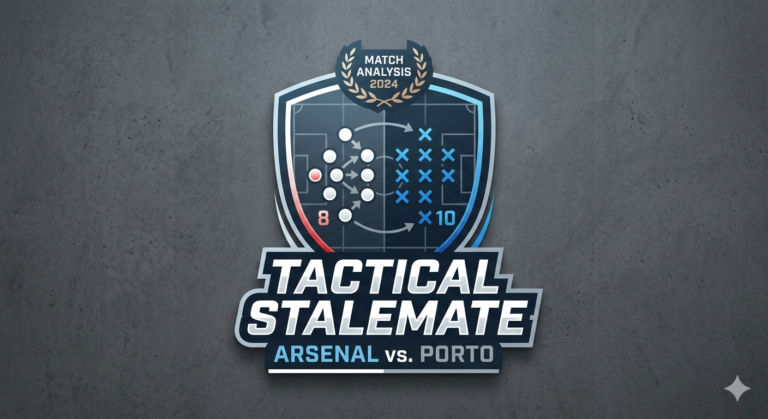
The latest clash between Arsenal and Porto didn’t offer a blizzard of goals, but for tactical purists, it was an absolute feast. It was a classic “immovable object vs. unstoppable force” scenario that ended in a cagey, fascinating draw, highlighting the high-leverage chess match that defines knockout football.
The defining characteristic of the match was the tension between Arsenal’s offensive patience and Porto’s structured defiance. Here is a deep dive into the variables that defined the stalemate.
Porto’s Deflection Doctrine
Sergio Conceição’s Porto didn’t come to play; they came to neutralize. Their strategy was built around a rigid low block that sacrificed possession for structural integrity.
The primary objective was to stifle Arsenal’s creative central funnel.
- The No-Go Zone: The Porto midfield, led by a relentless Alan Varela, worked tirelessly to block passing lanes into Martin Ødegaard. Arsenal’s primary playmaker was often surrounded, forced to play negative or lateral passes rather than those intuitive, defensive-splitting balls he thrives on.
- The Full-Back Trap: When Arsenal did bypass the center, Porto’s compact shape shifted rapidly. Their compact structure squeezed the space, forcing Arsenal to use the full width of the pitch. Bukayo Saka and Gabriel Martinelli were constantly doubled-up on, preventing the isolation 1v1 battles they needed to create efficient attacks. This was not chaotic defending; it was synchronized engineering.
Arsenal’s Patience vs. The Shot Count Trap
While Arsenal dominated territory, their shot selection told the true story of the match. For large portions, they fell into Porto’s trap. Arsenal became too methodical, moving the ball horizontally while seeking the “perfect” opening that never came.
The frustration peaked around the 60th minute when a series of slow-buildup attacks ended in desperate long-range shots that rarely tested the keeper. Arsenal was forced into low-probability actions because the high-value areas (inside the box) were completely colonized by white and blue jerseys.
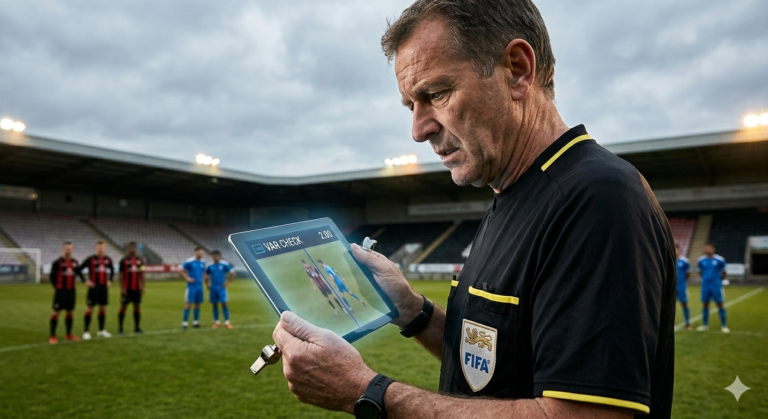
However, Mikel Arteta’s tactical patience did yield a moment of pure logic. When Arsenal finally did commit numbers forward with dynamic vertical runs, they unlocked the defense. That precise, late incision, ending in a near-goal that was agonizingly disallowed by VAR, was a glimpse of the efficiency that has been their league hallmark. It was the only time they truly calculated and overcame the defensive equations Porto had set.
The Variables for the Second Leg
The 90-minute war of attrition has set a precarious stage for the return fixture. The tie remains perfectly balanced, with the variables shifting dramatically.
- The Pressure Shift: Arsenal must now find the intuitive spark to bypass the defensive block they know is coming. The psychological load increases exponentially with every minute without a goal.
- Porto’s Counter-Attack ROI: If Arsenal commits too much to the offensive calculus, Porto’s rapid transitions become a catastrophic risk. Their ability to turn a defensive interception into a full-sprint counter-attack is the single variable that can wreck Arsenal’s Champions League strategy.
The stalemate wasn’t a failure of attack; it was a masterclass in controlled, defensive entropy.
About The Author